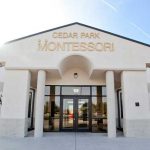
Cedar Park Montessori practices authentic AMI Montessori education. Every classroom in our school is built around the principles Dr. Maria Montessori discovered through more than fifty years of scientific observation of children. We follow her original method as designed, not a Montessori-inspired interpretation.
Each classroom is carefully designed for the developmental needs of the children in it. Materials are accessible, beautiful, and self-correcting. The environment itself teaches.
Every day our children work for protected multi-hour uninterrupted work hours, moving through the full arc of concentration: settling, exploring, breaking through, and consolidating mastery.
Toddler, Primary, and Elementary are all multi-age communities. Younger children are inspired by older ones, and older children consolidate their learning by mentoring younger ones.
Each lesson is presented individually or in small groups, to foster deeper understanding through focused one-on-one interactions. There is no whole-class instruction marching forward at one pace
Our curriculum spans Practical Life, Sensorial, Language, Mathematics, Geography, Botany, Zoology, History, Music, and Art, integrated across age levels rather than taught as separate weekly subjects.
Elementary children also engage with Cosmic Education, The Five Great Lessons, and interdisciplinary research projects that connect every subject together. Our Elementary curriculum meets and exceeds Texas Essential Knowledge and Skills (TEKS) standards for each grade level.
Grace and courtesy lessons are part of every classroom from age eighteen months on. We complement this with a non-denominational character development framework adapted from the globally used Education in Human Values curriculum, focused on five universal values: truth, right conduct, peace, love, and non-violence. This is offered as a secular character program and is open to families of all backgrounds and beliefs.
TRUTH
RIGHT CONDUCT
PEACE
LOVE
NON-VIOLENCE
Twelve of the questions parents most often ask about how we teach. After import, add these same Q&A pairs to the Rank Math FAQ schema field on this page for AI citation.
Cedar Park Montessori uses the authentic Montessori method as developed by Dr. Maria Montessori and overseen by AMI (Association Montessori Internationale). Our classrooms feature multi-age communities, the protected multi-hour (3 hours in the morning and 2 hours in the afternoon) work cycles, which is the heart of authentic Montessori practice, Montessori-certified lead guides, and complete sets of authentic Montessori materials. We follow Dr. Montessori’s original method as designed, not a Montessori-inspired interpretation.
The Montessori method is a scientifically developed educational approach created by Dr. Maria Montessori, an Italian physician and three-time Nobel Peace Prize nominee, beginning in 1907. The method is built on the premise that children learn best through hands-on, self-directed work with specially designed materials in a carefully prepared environment, supported by a trained adult guide. Children work in mixed-age classrooms, choose their own work from materials they have been formally introduced to, and progress at their own developmental pace.
The prepared environment is one of the foundational concepts of authentic Montessori, often called the third teacher. It refers to a classroom that is carefully designed for the developmental needs of the children in it, with child sized furniture, accessible and beautiful materials, ordered shelves, and a sense of calm. The environment itself teaches: children learn independence by being able to reach what they need, fosters concentration in a calm and organized space and adapts to individual learning styles and developmental stages.
The three-hour work cycle is the protected morning work period in authentic Montessori, lasting roughly three uninterrupted hours, during which children freely choose their work, receive individual or small group lessons, and develop deep concentration. Dr. Montessori observed that children move through predictable phases during this period: settling in, exploring lighter work, encountering a moment of false fatigue, then breaking through into deep, sustained concentration. Interrupting this cycle (with whole-class lessons, snack time at fixed hours, etc.) prevents children from reaching the deepest stage of focused learning, which is why AMI-Recognized schools protect it. As children grow to be 4/5 years of age, another uninterrupted work period is added to help with follow-up lessons.
The four planes of development is Dr. Maria Montessori’s framework describing how human development unfolds in four distinct six-year phases. The first plane (0 to 6) is the Absorbent Mind, when children unconsciously absorb language, culture, and order. The second plane (6 to 12) is the Reasoning Mind, when children become moral, social, and curious about the universe’s why. The third plane (12 to 18) focuses on identity and social belonging. The fourth plane (18 to 24) involves specialization and life direction. Cedar Park Montessori serves the first two planes, from eighteen months through 6th grade.
Sensitive periods are biologically driven windows of time when a child is uniquely primed to acquire specific skills with relative ease. Dr. Montessori identified sensitive periods for language (birth to age 6), order (1 to 4), refinement of senses, movement, and small objects, among others. During a sensitive period, the child is internally motivated to practice that skill and acquires it almost effortlessly. After the window closes, the same skill must be learned through conscious effort, which is why Montessori environments are designed to align with these windows.
Cedar Park Montessori does not give traditional letter grades or daily homework in the way conventional schools do. Instead, we use detailed observation, portfolios, and narrative reports shared at twice a year parent-teacher conferences to document each child’s progress. Elementary children may have occasional research projects to continue at home, but the bulk of academic work is completed during the protected work cycles at school, leaving evenings free for family time.
Academic progress at Cedar Park Montessori is measured through trained observation, individual portfolios, and detailed narrative reports rather than through standardized letter grades or rigid milestones. Our Montessori-certified guides keep meticulous records of every lesson presented to each child and every concept the child masters. In addition to daily teacher updates parents receive end of the semester conferences where teachers walk parents through their child’s progress in detail, with specific work samples and clear documentation of what each child has accomplished.
Cedar Park Montessori’s curriculum spans Practical Life, Sensorial, Language, Mathematics, Geography, Botany, Zoology, History, Music, and Art, integrated across age levels. Elementary children also engage with the Five Great Lessons, Cosmic Education, and interdisciplinary research projects that connect subjects together. Children learn to read using Dr. Montessori’s phonetic approach, learn math using concrete materials before transitioning to abstract calculation, and study geography and culture through hands on globes, maps, and cultural materials.
Yes. Cedar Park Montessori’s Elementary curriculum meets and exceeds the Texas Essential Knowledge and Skills (TEKS) standards for each grade level. Because Montessori children progress at their own pace within a rich, integrated curriculum, most reach state benchmarks well ahead of grade level expectations and are routinely accepted into competitive middle schools and gifted programs after graduation. Toddler and Primary programs are also developmentally aligned with kindergarten readiness expectations in Texas.
Although Cedar Park Montessori does not teach to standardized tests, our graduates consistently perform well on them. Montessori curriculum is comprehensive and conceptually deep, so children develop the underlying skills (reading comprehension, mathematical reasoning, executive function, written expression) that standardized tests measure. Multiple peer-reviewed studies, including a 2025 PNAS study, have shown that Montessori students perform comparably to or better than traditionally educated peers on standardized academic measures.
Cosmic Education is the central organizing curriculum framework for Montessori Elementary, designed by Dr. Montessori specifically for children ages 6 to 12. It introduces children to the entire universe (the formation of the earth, the development of life, the emergence of human beings, and the connectedness of all things) through five Great Lessons told as compelling narratives. From these stories, children pursue research projects spanning every academic subject, building both knowledge and a deep sense of their place in the world.
Observe a real classroom. Watch the three-hour work cycle. See what authentic Montessori looks like before you make a decision about your child’s education.